Languages Limemo can transcribe and summarize
Transcription covers 99+ languages and the language is detected from the recording. Translating the summary is a separate step, and its picker offers twelve languages.
Two different things, and mixing them up is the usual confusion.
Transcription works in 99+ languages. You do not choose one: the language is detected from what was actually said, and the transcript comes back in it.
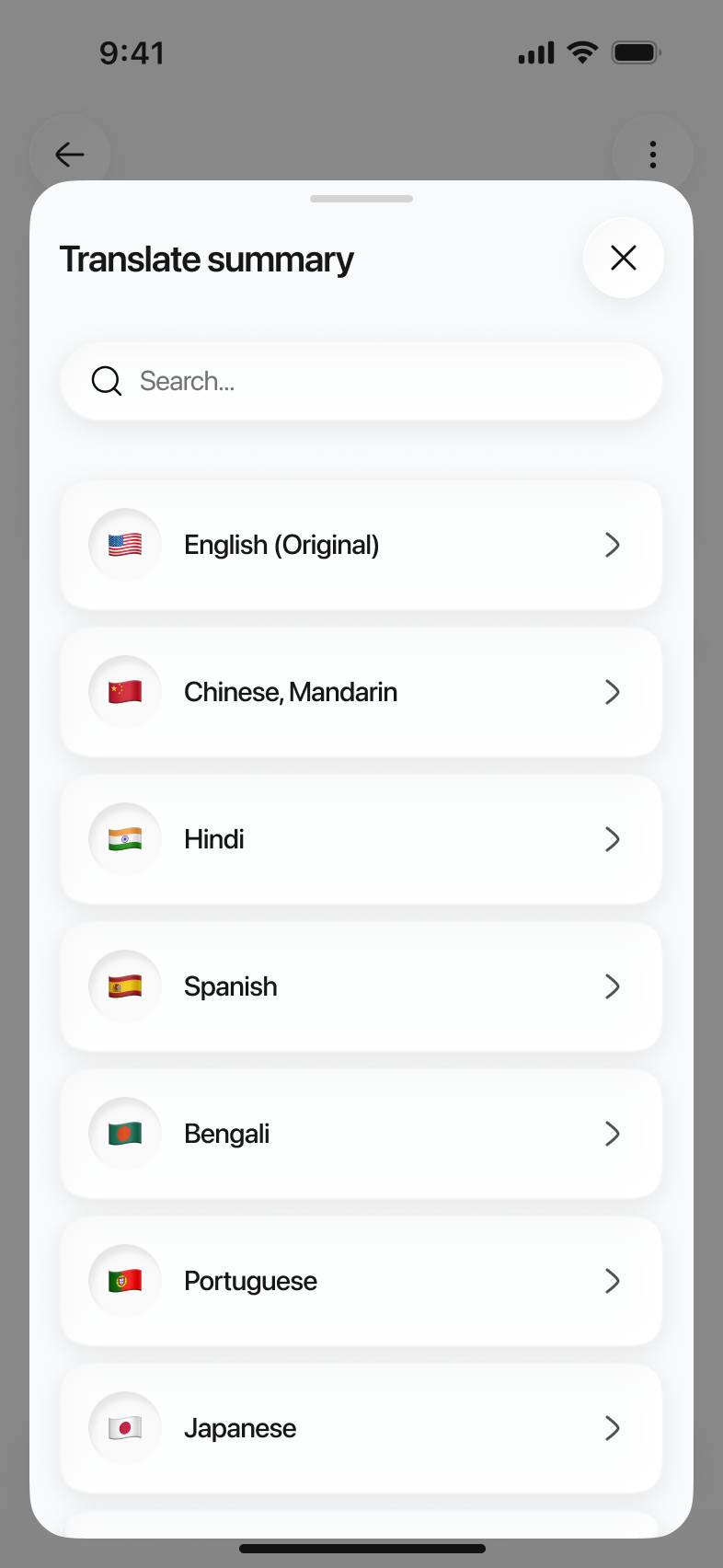
Translating the summary is a separate control, and it has its own list. Limemo’s language picker offers twelve: English, Chinese (Mandarin), Hindi, Spanish, Bengali, Portuguese, Japanese, German, Korean, French, Ukrainian and Italian. So a lecture in any of the 99+ transcribes fine, and the summary of it can be read in one of those twelve.
- Record or import as usual. Nothing to set — the language comes from the recording.
- Open the note and go to the summary.
- Tap Translate Summary, or open Summary Language from the customise sheet.
- Pick a language. The one your recording was in is marked (Original), and the list is searchable if you would rather type than scroll.
- The summary is regenerated in that language while the transcript stays exactly as it was spoken.
The latest translation is kept with the note, so switching between it and the original is instant; translating into another language replaces it. It comes back with the note after a reinstall.
If that didn’t work
- The translation did not arrive. Limemo keeps your existing summary and offers a retry rather than leaving you with nothing. Retry it when you have a connection.
- The wrong language was detected. The transcript is written once from the audio and does not change afterwards, so there is no language switch to flip. Re-import the recording and check the result, and if it is consistently wrong, tell us which language it was — that is a transcription issue rather than a setting.
- A quiet or noisy recording. Background noise is not removed. A café table records like a café table, in any language.
Can I transcribe in one language and read the summary in another?
Yes, and that is the normal way to use it. The transcript stays in the language of the recording — it is the record of what was said — and the summary is what travels. Translate the summary, and the original words stay untouched underneath it.
Still need help?
Write to us and we will take it from there. Contact · support@orvanta.limited