The Study summary format for lecture recordings

What Limemo's Study format produces from a lecture recording: key concepts, definitions, examples and review questions, and when to pick it over Standard.

Start taking smarter notes today

Record, transcribe and summarize on iPhone and Apple Watch.

Coming soon

Free to try. Cancel anytime. *

  • Apple Watch app
  • 99+ languages
  • Encrypted in transit and at rest

What you get

Key concepts
The ideas the recording is actually about, in the order they were introduced, so the summary follows the lecture rather than reordering it.
Definitions
Terms as they were defined in the recording, kept close to the original wording instead of paraphrased into something vaguer.
Examples
The worked examples and cases used to explain each concept — usually the part that makes revision click.
Review questions
Questions drawn from the material, to test yourself with before you go back to the transcript.

Sample output

Input: A 12-minute excerpt of an undergraduate microeconomics lecture on supply and demand.

Key concepts
- The lecture set out supply and demand as two schedules that meet at a single price.
- Market equilibrium was defined as the price at which quantity supplied and quantity demanded are equal.
- A shift of a curve was separated from a movement along it, which the lecturer called the most common exam mistake.
- Surplus and shortage were introduced as what follows when the price sits above or below equilibrium.

Definitions
- Demand: the quantity buyers are willing and able to buy at each price, with everything else held constant.
- Supply: the quantity sellers are willing to offer at each price, with everything else held constant.
- Equilibrium price: the price at which quantity supplied equals quantity demanded.
- Ceteris paribus: the assumption that every other influence is held fixed while one of them is varied.

Examples
- The lecturer used a poor coffee harvest to shift the supply curve and traced the new equilibrium price.
- A rent ceiling set below the equilibrium rent was used to show a shortage that does not clear.
- Bus fares were used to separate a movement along the demand curve from a shift of the curve itself.

Review questions
- What is the difference between a shift of the demand curve and a movement along it?
- Which way does the supply curve move after a poor harvest, and what happens to the equilibrium price?
- Why does a price ceiling below equilibrium produce a shortage rather than a lower bill for everyone?
- State the ceteris paribus assumption in your own words and name one influence it holds fixed.

Best for

  • Lectures and seminars you want to revise from
  • Long recordings where you need the definitions
  • Course videos and readings, not just live classes

How to use it in Limemo

  1. Record the lecture on your iPhone, or import the audio, video or PDF you want to work from.
  2. Open the note once the transcript is ready. The transcript comes with speaker labels, so the lecturer and questions from the room stay separate.
  3. Choose Study as the summary format.
  4. If the default shape is not quite right, add free-text instructions — for example, more definitions and fewer examples — and regenerate.

The transcript stays under the summary, so anything the summary compresses is still there in full. You can ask the AI about the note afterwards, translate the summary into another language, or export it as TXT or PDF.

When to pick something else

Pick Memo when a recording has to become a document you forward, or Standard for a voice memo or a short conversation; Study assumes there is teaching material in the recording. Pick Brief when you only want the gist, and Executive or Key KPIs for work meetings. If none of them fit, Custom takes a description of the format you want.
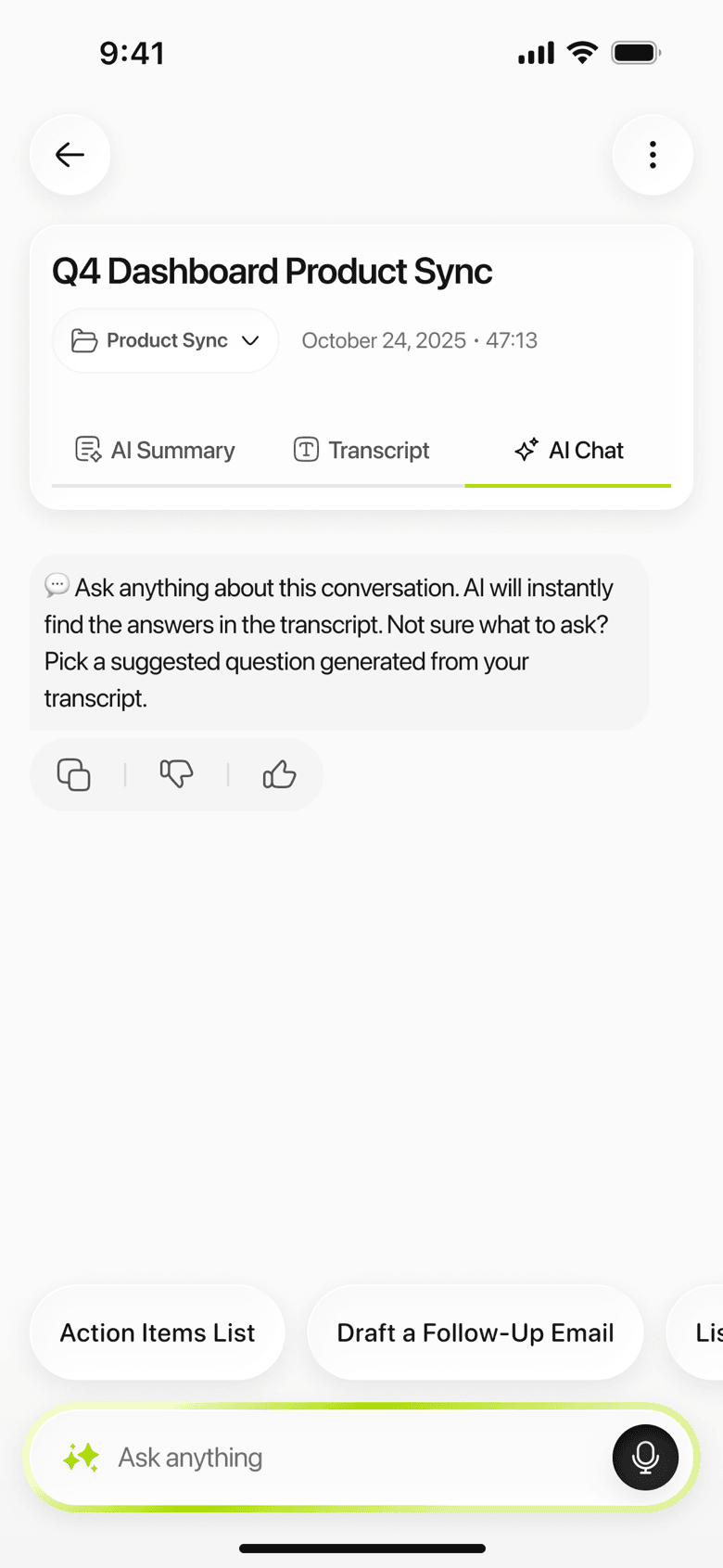
Limemo on iPhone: a summary of a recording, with a chat about it underneath
The summary as it arrives in the app, with the chat under it.

Frequently asked questions

How is Study different from the Standard summary?

Standard gives you a readable recap of the recording. Study reshapes the same material for revision: concepts first, then the definitions as they were given, the examples used in class, and questions to test yourself with.

Can I change what the Study format produces?

Yes. Every summary can take free-text instructions, so you can ask for more definitions, fewer examples, or the questions in a particular style. There is also a Custom format if you want to describe the whole shape yourself.

Does Study work on an imported file or a PDF?

Yes. An imported audio or video file and an imported PDF become the same kind of note as a recording, so you can apply the Study format to any of them.

See plans and start your free trial

Coming soon